
Industry News

GCA Product
See the entire gaming market. Control the legal. Expose the illegal.
At a glance
The problem
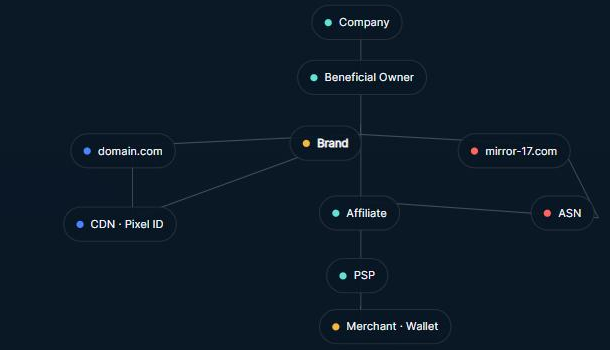
Traditional blocking targets a URL. A blocked operator returns the next day on a new domain, with the same brand, the same affiliates and the same payment infrastructure behind it, and the regulator starts again.
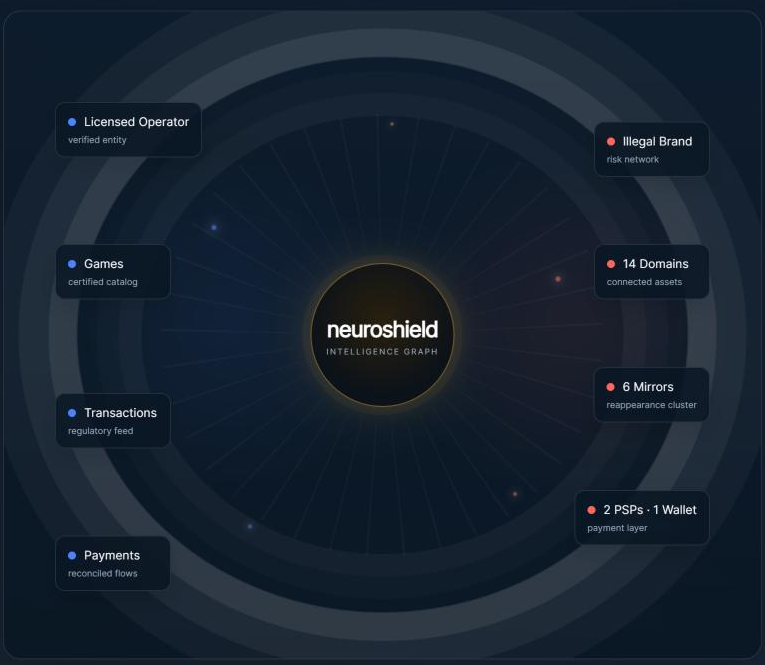
NeuroShield identifies the economic and technological network behind the domain: the company, the beneficial owner, the brand fingerprint, the affiliate codes, the merchants, the payment service providers and the wallets. Enforcement then acts on the network rather than on whatever domain it is using today.
The scale of the problem
$5.9 trillion
Estimated global unregulated online gambling handle in 2025
Up from $5.7 trillion in 2024 and $5.1 trillion in 2023. Unregulated operators are estimated to take roughly 78% of global online gambling gross gaming revenue (GGR), against 22% for regulated operators.
Handle is the total value wagered, not operator revenue — the same money is staked and re-staked many times over. It is also an online-only estimate from a single commercial source, not an audited or government figure.
Source: Gaming Compliance International (GCI), "GCI Online Gaming 2025: Global"
NeuroShield is a national Gaming Intelligence, Control and Enforcement platform built for gaming regulators, governments and financial authorities. It unifies market access, real-time control, illegal-market intelligence, payments, AML, player protection and enforcement into one operating model.
GCA developed the platform out of its own regulatory practice. The design reflects how a regulator actually works: a licence is granted, a market is monitored, an illegal operator is found, an enforcement action is taken, and somebody has to be able to show afterwards whether it worked.
What it correlates
11 signal types, cross-referenced to build the network behind a single domain.
One platform
01
See what operates outside the regulated market.
Discover illegal operators, infrastructure, payments and networks across the open web.
02
Know what happens inside the licensed market.
Real-time and near-real-time monitoring of operators, games, transactions and devices.
03
Protect players without compromising the intelligence perimeter.
Age verification, self-exclusion, AML and responsible gaming in an isolated protected environment.
04
Turn data into action.
Licensing, investigations, inspections, fiscal control, enforcement, appeals and reporting in one place.
Core capabilities
Find illegal operators before they become established.
Keep blocked operators blocked by discovering mirror infrastructure automatically.
Independent visibility into the regulated market.
Disrupt payments, not just websites.
Technical authorization and certification as a gateway to legal market access.
Create a regulatory source of financial truth.
Gaming intelligence meets financial intelligence.
Observe responsible-gaming compliance continuously.
Closed-loop enforcement
The platform measures whether a regulatory decision actually worked, not merely whether a notice was sent.
01
Web, apps, ads, mirrors, payments.
02
WHOIS, DNS, ASN, screenshots, payment clues.
03
Explainable risk score and a human decision.
04
WORM storage, hashes, timestamps, legal basis.
05
ISPs, banks, PSPs, stores, registrars, ad networks.
06
Measure blocking and takedown outcomes.
07
Mirror reappearance returns to discovery.
See it running
Executive visibility across market health, licensed operators, illegal networks, enforcement, AML, responsible gaming and fiscal reconciliation.
Channelisation
62%
Active operators
148
6 under review
Illegal networks
312
42 high priority
GGR variance
1.8%
across reporting population
Open AML cases
128
17 escalated
RG compliance
91%
licensed population
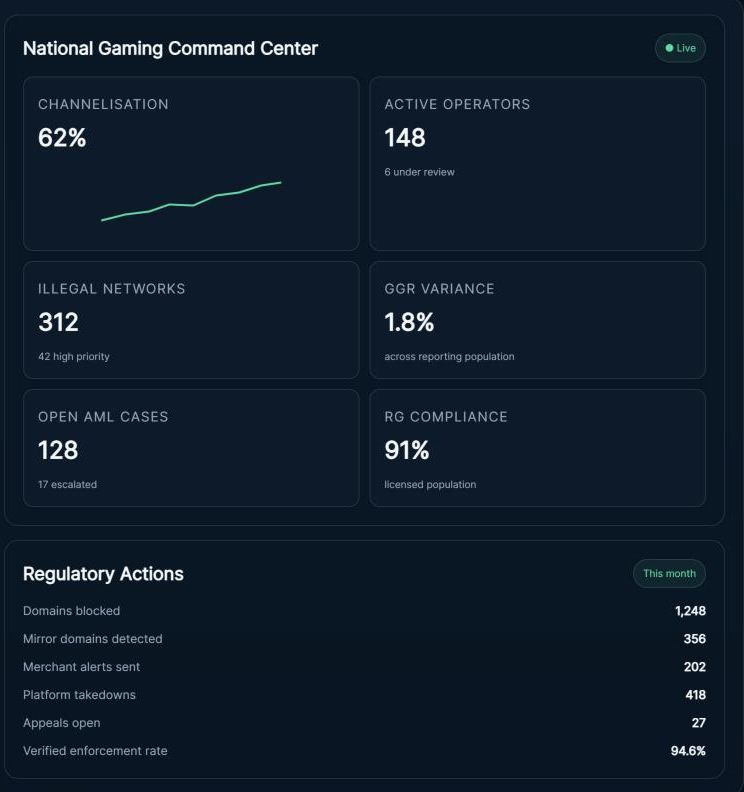
Figures shown in the platform screens are illustrative and describe the platform's capabilities, not measured results.
What this means for a government
Four platform capabilities, four concrete effects on the market a government is responsible for.
Channelisation — the share of play happening through licensed operators rather than illegal ones — is a figure the platform measures directly. Every player who moves from an unlicensed site to a licensed one becomes activity that is visible, reportable and part of the declared GGR a government can actually tax.
Enforcement targets the company, the beneficial owner, the affiliate codes and the payment rails behind an illegal operator, not only its current domain. An operator that has to rebuild its infrastructure after every action stays disrupted for longer than one that only has to register a new domain.
NeuroShield Reconcile checks what a licensed operator declares against what the platform independently observes — wagers against settlements, meters against game events — so a variance becomes visible to the regulator, not only to the operator.
Payment-layer intelligence — merchant IDs, acquirers, payment service providers, crypto wallets — turns "an illegal operator exists" into a specific merchant account or wallet that a bank, PSP or financial authority can take action against.
Who it is for
Licensing, monitoring, enforcement and fiscal control in one system.
The ministries responsible for licensing policy, fiscal policy and national market strategy.
Payment-layer intelligence and AML typologies specific to gaming.
Evidence packages with chain of custody for proceedings.
Regulatory-grade architecture
Deploy in a government data centre, sovereign cloud or dedicated national cloud, with open standards, local control and strong data separation.
Briefings are given to regulatory authorities, ministries and financial authorities, on request and under confidentiality.
Request a private briefingFrom the archive
Cookies on this site
Strictly necessary cookies keep the site working. Analytics and marketing cookies are off until you turn them on. See our cookie policy .