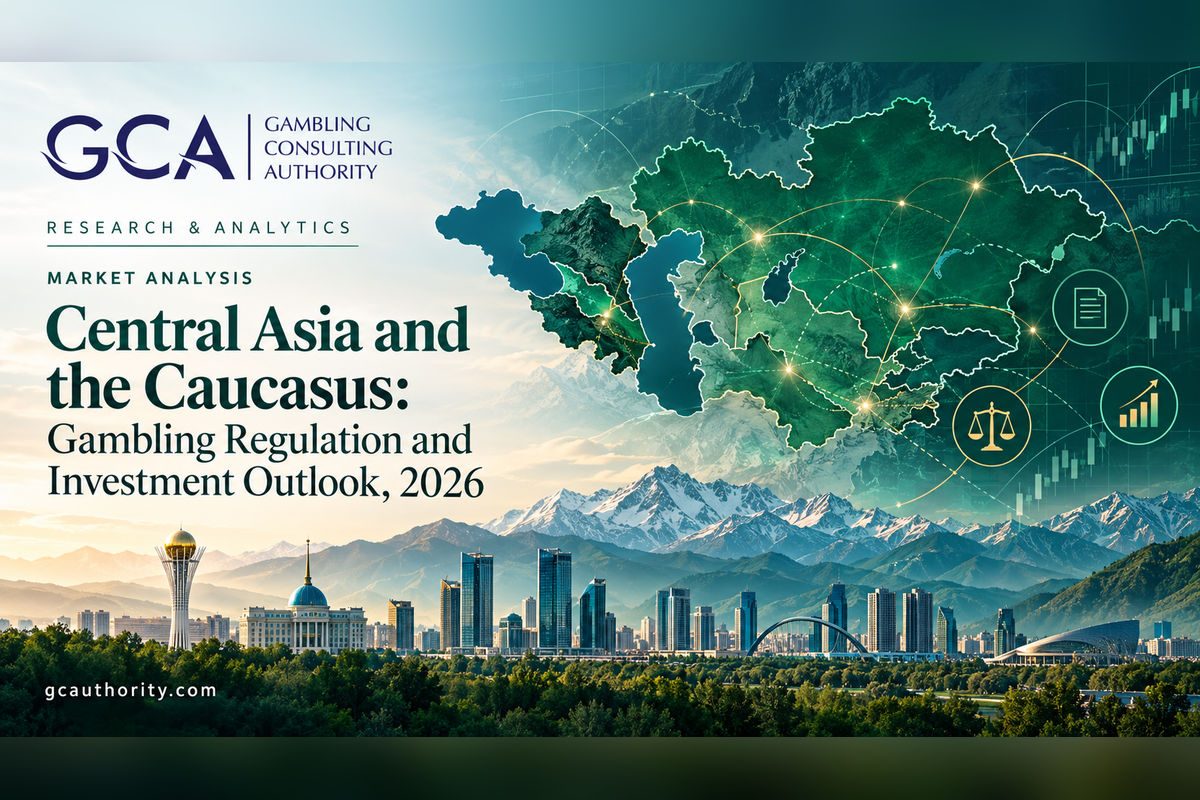
Central Asia and the Caucasus: Gambling Regulation and Investment Outlook, 2026
Key findings
• Central Asia (about 84 million people) is moving from prohibition and tight restriction towards differentiated national models: land-based tourism zones in Kazakhstan, state-registered online licensing in Uzbekistan, a foreigners-only casino regime in Kyrgyzstan, and closed markets in Tajikistan and Turkmenistan.
• Digital payments (mobile, banking apps, QR) and online identity verification make offshore gambling sites accessible within seconds. In all five markets the effective regulatory question is where the player plays, not where the operator is registered.
• The main structural risk is channelisation failure. Excessive entry costs (Uzbekistan), exclusion of domestic players (Kyrgyzstan), outright prohibition (Tajikistan, Turkmenistan) and heavy pressure on licensed operators (Kazakhstan) each leave demand to be met by illegal operators.
• Investment attractiveness depends less on headline tax rates than on rule stability, licensing speed, banking access and local presence requirements. Transparency of ownership and KYC capability are becoming common entry conditions across the region.
• Georgia is the closest regional benchmark for a mature, data-driven regulated market and is positioning a foreign-player licence (5% GGR tax, five-year term) as a hub model.
Scope and basis
This assessment covers the five Central Asian states, with Georgia, Armenia and Azerbaijan as reference markets from the Caucasus. It is based on regulatory developments through 23 September 2026, publicly available market indicators and GCA expert analysis. Figures for 2026 are estimates or forecasts unless stated otherwise. Sources and basis are set out at the end of the document.
1. Market context
Country | Population (approx.) | Current model | Key 2025–2026 development |
Uzbekistan | 38.2 m | State-registered online licensing | Framework built since 2025; first licences issued July 2026 |
Kazakhstan | 21 m | Licensed land-based casinos, slot halls and betting; online sports betting legal, online casinos banned | Four new foreigner-only casino zones (March 2026); Alatau special regime from 1 July 2026 |
Tajikistan | almost 11 m | Casinos and slot machines prohibited | No change; online access persists |
Kyrgyzstan | 7.5 m | Casinos for foreign visitors aged 21+; virtual casino licences | Regulated gambling restored in 2022 after almost a decade of prohibition |
Turkmenistan | 7 m | Almost no openly regulated market | No change |
Population structure is young, and use of digital payments, banking applications and online identification is growing in all five markets. For regulators this removes the practical significance of operator location: a player can reach almost any gambling site regardless of where it is licensed.
A licensed market gives the state three instruments: tax collection, payment monitoring and player protection. Each weakens as activity moves to illegal operators. Regulation that addresses only licensed operators is therefore incomplete.
2. Country assessments
Kazakhstan
Kazakhstan has the most mature regime in the region. Casino activity was previously limited to two zones, Konaev (Kapchagay, Almaty region) and the Shchuchinsk-Borovoye resort area (Akmola region), both open to residents and foreign visitors. Amendments to the Law “On Gambling Business” signed in March 2026 add four zones open to foreign citizens only: Mangistau (Caspian coast), Panfilov district and the shores of Lake Alakol, Talgar district, and the Markakol area with Zaisan district. Government Resolution No. 767 of 26 August 2026 defines the territories for casino placement and the gaming zones. The policy logic is tourism and investment: gaming destinations generate demand for hotels, catering, transport and entertainment. The city of Alatau, which operates under a special legal regime from 1 July 2026, is a further point of interest for investors.
Assessment: The state has strong visibility over licensed activity (bets, players, payments). The risk is asymmetry: if pressure on the legal sector grows faster than enforcement against illegal sites, some players will migrate. Website blocking alone is insufficient, as the number of illegal platforms is likely considerably higher than the number blocked.
Uzbekistan
Under Presidential Decree No. UP-68 of 19 April 2024, Uzbekistan has been building, from 1 January 2025, a regulated online gaming and betting market on the basis of a state register, KYC and AML requirements and full visibility of players and payments. Entry requirements cover capital, reserve funds, local infrastructure, certification and annual costs; the minimum authorised capital of UZS 56.25 billion and reserve fund of UZS 28.125 billion together amount to roughly USD 7 million. Tax rules remained unclear for an extended period, and the first licences were issued only in July 2026.
Assessment: The regulatory design is modern, but the cost of entry is the main constraint. High thresholds screen out financially weak operators, but if too few operators qualify, the legal offer remains limited and illegal sites retain demand. Given its population (the largest in the region) and payment infrastructure, Uzbekistan has the highest investment potential in the region, conditional on stable rules and a better balance between control and market accessibility.
Kyrgyzstan
Kyrgyzstan restored regulated gambling in 2022. The model is tourism-led: casinos accept foreign visitors aged 21 and over, and Kyrgyz citizens may not play in them. Licences are also issued for virtual casinos.
Assessment: The tourism model supports hotels, restaurants and employment, but excluding residents does not remove local demand. Residents who cannot access a legal product may use unlicensed offshore sites, resulting in lost tax revenue, loss of market share for licensed businesses and loss of player protection. With Kazakhstan and Uzbekistan developing their sectors, a restrictive model may become economically costly.
Tajikistan and Turkmenistan
Casino and slot-machine activity is prohibited in Tajikistan, and Turkmenistan has almost no openly regulated market. Prohibition does not prevent access to online gambling sites.
Assessment: Neither state has reliable data on the scale of demand. Before considering a regulatory model, authorities need to establish how many people gamble, where, and how they pay. Experience of neighbouring markets provides reference models.
3. Reference markets in the Caucasus
Georgia
Georgia has long experience in regulating online gambling, a developed local and international operator base, and Tbilisi has become a centre for technology, payments and marketing teams. The regulator receives operator data and applies modern player-protection tools. Under Law of Georgia No. 1822 of 25 June 2026 (published 3 July 2026), a new permit for the international organisation of systemic-electronic gambling, in which Georgian citizens may not participate, is issued for five years; the 5% GGR tax is set by the Tax Code of Georgia. GGR was approximately USD 2.2 billion in 2025 on a turnover of USD 33.3 billion (an implied hold of about 6.6%, GCA calculation), with about USD 3 billion expected in 2026. On a population of about 3.7 million, 2025 GGR corresponds to roughly USD 590 per capita (GCA calculation).
Assessment: Georgia’s growth is associated with clear rules, strong regulatory oversight and openness to investment. It can serve as a source of regulatory practice and as a regional business base for Central Asian operators.
Armenia
In Armenia, online gambling has experienced rapid growth. The total amount of bets increased from approximately 0.2 trillion drams in 2017 to 7.4 trillion drams in 2025. Amendments adopted in 2026 (Law HO-279-N) tighten the rules on participation in gambling. In response to social concerns, the measures include stronger self-exclusion, restrictions for recipients of social support and player spending limits.
Assessment: Player-protection measures are justified, but without parallel action against illegal operators they may displace some players towards illegal sites.
Azerbaijan
After years of prohibition, casinos are again permitted, but only on artificial islands in the Caspian Sea (amendments of 8 July 2025). The aim is to bring gambling-related activity into a regulated environment while supporting tourism, tax revenue and investment.
Assessment: Projects are still being developed, and their outcome cannot yet be assessed.
The Armenian and Azerbaijani cases confirm that no single regulatory model fits the region.
4. Investor considerations
Tax is one of several factors. Operators and investors typically assess:
• stability of regulation and predictability of tax rules;
• licensing procedure and speed;
• banking and payment infrastructure;
• local presence requirements;
• market size and long-term growth potential.
Opportunity map: Kazakhstan offers tourism-oriented gaming zones and the Alatau project; Uzbekistan a large, newly regulated online market; Kyrgyzstan a tourism model with virtual casino licensing; Georgia an established regulated market with a foreign-player licence.
A common requirement is emerging across the region: transparency. Operators will need clear ownership structures, effective KYC and the ability to work with government and regulatory systems.
5. Cross-cutting policy priorities
1. Continuous action against illegal operators. Blocking individual domains is rarely sufficient because new sites can be launched quickly.
2. Payment monitoring. Cooperation between banks, payment companies and regulators to detect suspicious transactions and financial flows.
3. Practical player protection. Age verification, limits and self-exclusion work only when players remain within the legal market.
4. Fair taxation. Excessive rates create incentives for operators and players to move to the illegal sector.
5. Reliable market data on betting activity, payments, players and advertising.
A complete ban does not remove demand; it shifts part of it to illegal operators, where age control, limits, KYC and protection of player funds are weaker or absent.
6. Building a stronger legal market
Five principles can help guide the development of sustainable gambling markets.
First, the legal product must be attractive enough for players to choose it over illegal alternatives.
Second, the state must have sufficient visibility over the market.
Third, regulators, banks and internet companies need to cooperate.
Fourth, taxation should be fair and proportionate.
And fifth, player protection must work in practice rather than exist only on paper.
7. Recommendations
For regulators
• Set channelisation (share of gambling in the legal market) as a core indicator and measure it.
• Calibrate entry costs and tax so that the legal offer is competitive.
• Combine regulation of licensed operators with enforcement against illegal ones in the same policy package.
• In closed markets (Tajikistan, Turkmenistan), commission a market study before choosing a regulatory model.
For operators and investors
• Prepare ownership disclosure and KYC systems in advance of market entry.
• Model capital, reserve and local infrastructure requirements (for example in Uzbekistan) and the licensing timeline, which in practice has been slow.
• Consider Georgia as a regional operational and compliance base.
Conclusions
The region’s growth is likely to continue, but its sustainability depends on whether governments can move players into the legal market and keep them there. This requires clear frameworks, fair taxation, modern supervision, effective action against illegal operators and openness to responsible investment.
Sources and basis
This assessment draws on national legislation and official publications of the regulators of the countries covered, national statistics offices, United Nations population data, and GCA market data, calculations and analysis.
GCA provides regulatory analysis, market-entry strategy and expert assessments for governments, regulators and operators. Contact: gcauthority.com
Related markets
Related expertise