
The Illinois Senate Executive Committee will convene on Wednesday to review Senate Bill 2749, a measure that would expand the Illinois Substance Use Disorder Act to cover individuals struggling with gambling disorders.
Sponsored by Democratic Senator Julie Morrison, the bill was filed last month and formally assigned to the committee on 3 February. Morrison will present the proposal at the state capitol, joined by two witnesses—David Schwartz and Mathew Slade—who are expected to testify in support.
Under SB 2749, the Illinois Department of Human Services and the Illinois Board of Education would collaborate to develop counselling, referral, and supportive services. The legislation also calls for instructional resources focused on “gambling disorder prevention and awareness.”
Illinois has a long history of addressing addiction through legislation. In the 1990s, lawmakers passed the Alcoholism and Other Drug Abuse and Dependency Act (ILCS 301), which laid the foundation for education, prevention, and treatment programmes, including mandated services for DUI offenders. In 2018, the Act was modernised and renamed the Substance Use Disorder Act (HB4795, now PA 100-0759).
Additionally, Illinois is not alone in broadening its approach. Since the legalisation of sports betting in 2018, several states have recognised gambling as a public health issue. According to the 2021 Survey of Publicly Funded Programme Gambling Services, 42 states and the District of Columbia have invested in infrastructure to address problem gambling.
The proposal also mandates a toll-free hotline and a dedicated website offering crisis counselling and referral services for families affected by gambling addiction. Public awareness campaigns would highlight the consequences of gambling disorders on individuals, families, and communities.
A 2021 study by the Illinois Department of Human Services and Health Resources in Action found that 68 percent of adults reported gambling, with the state lottery as the most popular form.
Growth in video gaming terminals (VGTs) and online sports betting has further expanded access. The study also estimated that 3.8 percent of Illinois residents—about 383,000 people—struggle with gambling problems, while 7.7 percent, or 761,000 residents, are at risk. For SFY23, for instance, Illinois allocated $10 million to gambling disorder services, funding 26 treatment programmes and training over 245 clinicians.
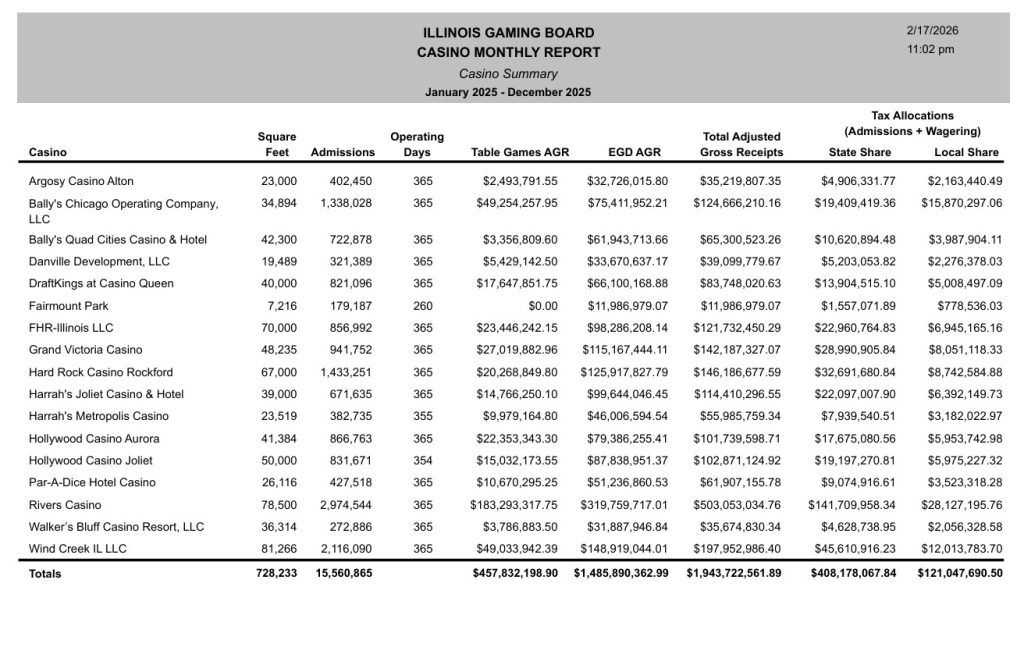
(Source: Illinois Gaming Board)
Faith-based organisations such as the Illinois Family Institute, along with industry stakeholders like VGT operators, remain vocal opponents of gambling expansion in Illinois. According to the Public Gaming Research Institute, these groups argue that broader access to online gambling—or iGaming—will intensify addiction risks, undermine small businesses, and trigger job losses within the state’s existing casino industry.
If enacted, SB 2749 could mark a pivotal step in Illinois’ efforts to reduce gambling-related harm, while expanding recovery and prevention programs statewide. According to the Illinois Gaming Board reports that the state already hosts 17 casinos, nearly 9,000 licensed video gaming terminals (VGTs), and 14 approved sportsbooks. Together, these regulated operations generated more than $2.2 billion in tax revenue for state and local governments in 2025.
Looking ahead, consultancy firm Eilers & Krejcik Gaming projects that legalised iGaming could add approximately $775 million in revenue within five years at a 25 percent tax rate. Several media reports suggest that with higher tax rates, annual revenue could surpass $1 billion.
#USGaming #GamblingDisorder #ResponsibleGaming #PublicPolicy #GamingRegulation #IndustryNews

Welcome to Gambling Consulting Authority (GCA) - Your Strategic Partner in Gambling Industry Advancement