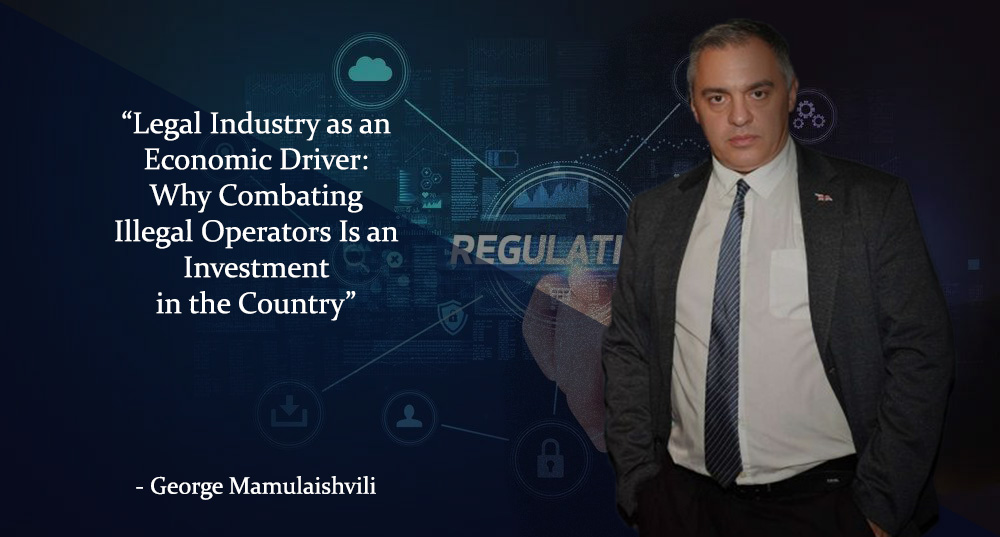
How the growth of licensed operators creates jobs, develops the banking sector and IT, and why effective enforcement against offshores is the key condition for this development
Author: George Mamulashvili
iGaming Regulation Expert • Founder, Gambling Consulting Authority • Senior Leadership Role at Georgian Gambling Association
Licensed gambling is not just a business. It is part of the economy. It means jobs, taxes, the IT sector, banking infrastructure, tourism. Building strong legal operators is more effective than fighting the illegal market through prohibition. And only when the state understands this does it begin a truly effective campaign against offshore operators.
A Hidden Crisis No One Wanted to See
For most people, the word "gambling" conjures a familiar picture: a licensed casino in the city, a betting shop on the street, a national lottery ticket. But behind this familiar picture lies a vast and rapidly growing shadow market that touches every country with internet access.
The numbers are difficult to grasp. According to industry analytics platform Yield Sec, illegal online gambling generates approximately five trillion dollars in turnover annually worldwide. That is more than the entire economy of Japan. That is more than the combined GDP of all Central European countries. And this figure grows faster every year.
In the United Kingdom — the country with the most developed gambling regulator in the world — the illegal market grew from 0.43 percent of all gambling activity in 2020 to 9 percent in the first half of 2025. That is a more than twentyfold increase in just five years. In the United States, where many states recently legalized sports betting, illegal operators still control 74 percent of the entire online market.
Until recently, most policy discussions about gambling were focused on the wrong question. Governments debated whether to permit gambling, how to tax it, how to restrict it. But they were not asking the more important question: how to stop illegal operators who are already serving their citizens, paying no taxes, following no rules, and growing stronger every day?
«It is more effective to develop strong legal operators than to fight the illegal market with bans.»
What Regulators Most Often Miss: the Legal Operator as an Economic Engine
When I speak with government officials about gambling, I frequently hear the same perspective: it is a "separate" sector — morally contentious, something to be restricted and controlled. I understand this position. But it is built on an outdated model.
Today, licensed gambling is not an isolated industry. It is a hub within a network of a dozen other economic sectors. When we undermine legal operators with strict regulations, we are not just affecting a single sector. We are severing links with the banking system, the IT sector, the advertising industry, sport, tourism and the staff training system.
Let’s take a closer look at what a licensed operator actually creates.
Direct Employment
A licensed operator is far more than call center operators. It employs finance professionals, risk managers, compliance specialists, platform engineers, product managers, data analysts, responsible gaming specialists, and legal professionals. A single mid-sized online operator typically creates 200–400 well-paid jobs. A large operator can support up to 1,000 positions.
The IT Sector and Services Exports
Licensed operators require a wide range of technology professionals, including frontend developers, backend engineers, cybersecurity specialists, DevOps engineers, machine learning engineers for fraud prevention systems, and data processing specialists. In many countries across the region, this is among the highest-paying segments of the IT labour market.
Even more importantly, an entire supporting industry develops around licensed operators: live casino studios, gaming content providers, and IT outsourcing companies serving international operators. This is a sector that not only serves the domestic market but also exports services worldwide.
The Banking Sector and Fintech
Licensed operators require acquiring services, card payment processing, local payment methods, escrow accounts, credit facilities for business operations, and foreign exchange services. The gambling industry is one of the largest clients of both the fintech sector and the banking industry.
This contributes to bank revenues, generates tax income, and supports the stability of the banking system. Most importantly from a regulatory perspective, it provides the state with full financial traceability of every transaction—something that is simply not possible with offshore operators.
Advertising, Sports, and Media
When gambling advertising is permitted within regulated and limited formats, it supports sports clubs through sponsorships, media organizations through direct advertising, and marketing agencies through creative services and media buying. When a government imposes a complete ban on gambling advertising, it simultaneously removes a source of funding for football clubs, sports federations, and the media industry. The development of sports media also contributes directly to greater gender balance, as operators often invest in sponsorship initiatives such as sports broadcasting and the promotion and development of women's sports.
Tourism
Licensed land-based casinos—particularly those located in resort destinations—attract visitors from neighbouring countries where gambling is prohibited. These tourists spend money not only in casinos. They stay in hotels, dine in restaurants, take part in excursions, and rent vehicles, generating economic activity across the broader tourism sector.
Taxes — Direct and Indirect
Direct taxes from operators: taxes on GGR, profits, and dividends. Indirect taxes: personal income tax from thousands of employees, VAT from related services, and taxes on suppliers’ profits. According to our estimates, every lari earned by a licensed operator generates for the state, in the form of direct and indirect taxes, 1.5–2 times more than the operator’s own net revenue after taxes.
The Multiplier Effect
When we combine these six factors, we get what economists call the multiplier effect. According to our estimates, one dollar of profit generated by a licensed operator creates an additional 2–3 dollars of economic activity in related sectors.
Compare this with an offshore operator. One dollar sent offshore generates zero jobs in your country. Zero taxes. Zero growth for a local bank. Zero contracts for local IT companies. Zero sponsorship for a football club.
This is simple mathematics that regulators may find difficult to accept, but it has proven true in every country where it has been measured. Every licensed player is part of the country's economy. Every player who moves offshore is an investment in someone else's economy.
«Every legal player is part of the country's economy. Every player who moves offshore is an investment in someone else's economy.»
Georgia — A Real-World Example of Gambling Becoming Part of the Economy
A small country with a population of around 4 million has, over two decades, built one of the most transparent regulatory models in the region and turned gambling into a fully developed sector of its economy. Today, the market consists of 126 licensed operators: 9 online platforms, 28 land-based casinos, 63 slot clubs, 25 betting shops, 51 live studios and gaming content providers. In 2024, the market turnover reached €24.6 billion, with GGR of €2.05 billion. The market is growing at 20–25 percent annually.
The transparent environment has attracted publicly listed international companies — Entain (LSE), Flutter (NYSE), Betsson AB (Stockholm). On this foundation, Smartsoft Gaming and Spribe have grown — companies founded in Tbilisi that today export gaming content to dozens of jurisdictions worldwide. Spribe created Aviator — one of the most popular crash games globally. This is a pure export of high-tech services that would not have emerged without a strong local licensed base.
In 2024, licensed operators paid the state 1,476 million GEL in direct taxes — a 54 percent increase compared to 2023. This does not include personal income tax from 6–8 thousand direct employees in the industry, taxes from the related tourism sector, and revenues of the country’s three largest banks — TBC Bank, Bank of Georgia, Liberty Bank (public companies listed on the London Stock Exchange) — from servicing licensed operators. A small country with limited resources has turned gambling into a living sector of the economy by relying on a strong legal industry and transparent regulation. This is a working model.
* * *
How Other Countries Protect Their Legal Industry
If we look at countries that have best managed the balance between “developing a legal industry and effective law enforcement,” we see the same pattern.
Spain — 98% of the Market Remains in the Country
The Spanish regulator DGOJ has built, in my view, the best enforcement system in Europe. Local licensed operators generate €8.59 million in revenue. International — i.e., illegal — operators generate only €160,000. This is a 98 to 2 split in Favor of the legal market. Every top brand in Spain is a licensed brand.
What does this mean for the Spanish economy? It means that 98 percent of the money Spaniards spend on gambling remains in Spain — in the form of taxes, jobs, IT contracts, banking fees, and sponsorships. Only 2 percent goes offshore.
How this is achieved: strict licensing standards prevent weak operators from entering the market. A public register of illegal websites makes the regulator’s position transparent. Internet service providers block illegal websites at the DNS level. Banks block payments to unlicensed operators. A continuous market monitoring system tracks the situation in real time.
Italy — Aggressive Blocking with Real Penalties
The Italian ADM has taken a direct approach. By September 2025, the regulator had blocked more than 11,400 illegal gambling domains at the internet service provider level. At the same time, Italian banks are legally required to refuse payments to unlicensed operators, with fines of up to €1 million for each violation.
Result: 88 percent channelisation. Almost all top brands operating in Italy are licensed. This example is particularly valuable because Italy does not have the resources of the United Kingdom, yet it has achieved near-ideal results through a simple but consistent enforcement system.
United Kingdom — The Gold Standard with a Warning
The United Kingdom has long been considered the global gold standard. The Gambling Commission reports a channelisation rate of 97.6 percent. However, behind this figure lies an important warning.
The illegal market in the UK has grown from 0.43 percent of all gambling activity in 2020 to 9 percent in 2025. The majority of this growth — 84 percent of illegal traffic — is linked to the “not on GameStop” phenomenon: self-excluded players seeking offshore alternatives that bypass the UK’s self-exclusion program.
This illustrates an important principle: player protection rules are necessary, but they must be accompanied by strong enforcement against alternatives. Otherwise, they create a market for the illegal industry.
Germany — What Happens When the Legal Market Is Strangled
The German regulator GGL launched in 2023 with strong ambitions. However, in March 2024, the Federal Administrative Court ruled that IP blocking via internet service providers has no legal force under German gambling law. The regulator’s most important tool suddenly disappeared.
At the same time, Germany adopted a highly restrictive model for legal operators — a €1 stake limit per spin, a €1,000 monthly deposit limit, and a 5.3% turnover tax instead of GGR-based taxation. These restrictions made the legal market so uncompetitive that players massively migrated to offshore operators despite blocking measures.
Result: Germany’s channelisation rate remains at around 60 percent. There are two lessons: technical solutions must be based on a solid legal foundation, and overregulation can kill the legal market faster than the illegal one.
|
98% Spain’s channelisation rate is a global benchmark to strive for |
Lessons from Asia and Brazil
Asian markets are a laboratory of rapid and often painful change. The lessons provided by Asia are especially valuable because they show the limits of what is possible.
Philippines — The Cost of Inaction
The Philippines is a dramatic example of what happens when a state allows a gray market to grow too large. For more than a decade, the country allowed Philippine Offshore Gaming Operators (POGO) to operate with foreign players. At its peak, this was a billion-dollar industry accounting for more than 11 percent of the gambling regulator’s revenues.
Then investigations began. POGO hubs became centres of human trafficking, money laundering, and cybercrime. In Q3 2025, illegal gambling in the Philippines dropped by 93 percent following sustained enforcement action. But by that point, a former mayor had already received a life sentence for human trafficking.
Lesson: when an offshore market is allowed to grow unchecked, it becomes not an economic issue but a national security issue.
India — The Ban’s Trap
In September 2025, India banned all online real-money games. The intention was good — to stop gambling addiction and financial losses. The result was the opposite.
Domestic platforms had to shut down. But demand did not disappear. Indian players simply moved to offshore platforms in countries where the Indian government has no jurisdiction. Tax revenues went with them. Regulatory oversight disappeared. Harm to vulnerable players continued — but now without any tools of protection.
This is the ban’s trap. When you ban legal options without effectively stopping illegal ones, you do not solve the problem. You merely export it to a place where you cannot control it.
Japan — Strong Law, Weak Tools
Japan’s Criminal Code makes online gambling illegal. Articles 185–187 are very clear. Nevertheless, in 2024, Japanese citizens placed approximately $41 billion in bets on offshore sports betting websites. The Japanese regulator lacks the legal framework to directly block illegal websites at the internet service provider level. The law is strong on paper. Enforcement tools are weak in practice.
Brazil — How to Build a Market Properly
Brazil is the most important new case. On January 1, 2025, it launched its regulated online gambling market after many years of gray activity that had served approximately 20 million Brazilian players.
What makes Brazil unique is that it built enforcement alongside the market. In 2025, the regulator issued 68 licenses. The telecommunications regulator was granted authority to block illegal websites at the national level. Brazilian banks are required to block payments to unlicensed operators. In the first half of 2025, the regulator opened 66 enforcement cases against 93 operators, resulting in sanctions in 35 cases.
In December 2025, Brazil went further — approving Bill 4044/2025, aimed at the entire illegal gambling ecosystem: operators, payment processors, affiliates, and intermediaries. The Brazilian lesson is simple: when building a regulated market, enforcement must be built at the same time, not afterwards.
* * *
The Five Layers That Actually Work
Across all successful cases — Spain, Italy, the United Kingdom, and Brazil — the same five-layer enforcement architecture appears again and again. Countries that succeed combine all five layers. Countries that fail tend to miss one or more of them.
Layer 1: Network Blocking
This is the foundation. Internet service providers block illegal gambling websites at the DNS level — the most common and simplest method. More advanced systems use Deep Packet Inspection technology to detect illegal traffic even on non-standard ports and to block VPN circumvention. Vendors such as Sandvine, Allot, Cisco, and Fortinet provide this technology.
Layer 2: Financial Blocking
Every gambling card transaction carries a special code — MCC 7995. Regulators provide banks with a list of licensed operators. Any payment with code 7995 that does not go to a licensed operator is blocked. Card networks — Mastercard and Visa — run programs such as BRAM and GBPP, which detect operators attempting to disguise their real business under different merchant codes. Block the money, and you block the business.
Layer 3: Market Intelligence
You cannot fight what you cannot see. Platforms such as Yield Sec and Blask use artificial intelligence and machine learning to map the entire gambling market in any country — both legal and illegal. They identify operators, affiliates, content, and financial flows. For smaller jurisdictions, OSINT methods — using open-source intelligence — can provide useful results at low cost.
Layer 4: Affiliate and Advertising Control
Most players do not find illegal sites by chance. They find them through affiliates — comparison websites, social media posts, Telegram channels, YouTube streams. If you control these channels, you block the main gateway to the illegal market. Tools such as Google Ads and Meta Ads can be required to verify operator licenses. App stores can remove illegal applications upon regulator request.
Layer 5: Economic measures — the key layer
This is the most important layer, and it is often overlooked. The legal market must be competitive. If taxes are too high, licensed operators cannot offer attractive bonuses. If the regulations are too strict, players will turn to offshore operators for a simpler experience. The legal market must be the best market — not just the only legal one.
This is the point I constantly reiterate in meetings with the regulator. If we want to combat illegal gambling effectively, we must simultaneously strengthen the legal industry. We must not weaken it with regulatory restrictions, nor drive players away with harsh rules, but make it an attractive alternative to offshore operators.
* * *
Five Mistakes Regulators Continue to Make
Just as there are five layers that work, there are five mistakes that fail.
First — tightening rules for licensed operators without blocking illegal ones. This is the most common mistake. Governments try to reduce gambling harm, so they add more rules for licensed operators. But illegal operators do not follow these rules. The result: licensed operators become weaker, illegal operators become stronger, and player protection actually worsens.
Second — total ban. The example is India. Ban everything legal, and demand does not disappear; it moves underground, where it cannot be controlled. Tax revenues disappear. Protection disappears. Everyone loses except offshore criminals.
Third — building blocking systems without a legal foundation. The German experience shows this clearly. The regulator built technical systems for IP blocking, then the court ruled that the practice was illegal. All the work was wasted. Always build the law first, then the tools.
Fourth — focusing on operators and forgetting the ecosystem. Illegal gambling is not only websites. It is affiliates, payment processors, advertising platforms, and social channels. Block only websites, and the ecosystem will replace them within days.
Fifth — trying to act alone. No country can fight global illegal gambling alone. And no regulator can succeed without cooperation with the licensed industry. Operators have data and insights that regulators do not. Smart regulators use that knowledge.
* * *
Why the Legal Industry Is the State’s Key Ally
In every successful case study, I have observed the same truth—one that is uncomfortable for some regulators: the licensed industry is not the regulator’s enemy. It is, in fact, its most powerful ally.
Licensed operators have data that regulators do not. They see patterns in player migration. They know what marketing tactics offshore competitors use. They identify illegal affiliates faster than any government inspector. They have invested billions in compliance technologies that can be shared with the regulator.
When licensed operators are treated as partners — when there are formal channels for data exchange, joint identification of illegal sites, and joint policy development — the channelisation rate rises. When they are treated as suspects who need to be monitored, the channelisation rate falls. This is a consistent pattern from twenty years of regulatory experience worldwide.
I say this from the perspective of someone who has seen the industry from three angles — as an operator, a financial analyst, and a regulatory consultant. I understand why it is difficult for regulators to see us as allies. There are historical fears, political pressure and moral tension. But the figures don’t lie. Countries that work in partnership with the industry gain a 98% legal market and a strong economy. Countries that view the industry as an enemy lose operators, lose tax revenue and lose control of their own market.
«A licensed industry is not the regulator’s enemy. It is its most powerful ally.»
* * *
Where Are We Heading – And What Needs to Be Done
If we were to distil all this into a single idea, it would be this: effective gambling regulation is not a battle between the state and the industry. It is the state investing in its own economy through a strong legal industry.
Spain has proven this with its 98 per cent channelisation rate. Italy has proven this through aggressive blocking measures alongside a competitive legal market. Brazil is proving this right now by developing law enforcement alongside licensing.
Countries that try to combat gambling by tightening rules only for licensed operators, or by banning legal options without stopping illegal ones, lose out on every front. They lose tax revenue. They lose jobs. They lose investment in IT and banking infrastructure. They lose control of their own market.
This is the choice every government faces. It is not ‘gambling or no gambling’ — that question was settled when the internet made offshore gambling accessible to every smartphone user. The real question is: licensed and regulated — or illegal and uncontrolled? And the answer determines whether gambling taxes will fill your budget or someone else’s; whether jobs in the IT sector will be created in your country or offshore; whether your banking system will receive revenue from serving this industry or not.
The numbers speak clearly: every legal player is an investment in the country. Every player who migrates to an offshore operator is money flowing out of your economy and into someone else's. The path is clear. The examples are proven. The tools exist. What remains is the political will to put effectiveness above ideology.
#iGaming #GamingRegulation #Compliance #ResponsibleGambling #EconomicDevelopment #Fintech #GamingIndustry #DigitalTransformation #TaxPolicy #GeorgeMamulaishvili

Welcome to Gambling Consulting Authority (GCA) - Your Strategic Partner in Gambling Industry Advancement